Physical Address
304 North Cardinal St.
Dorchester Center, MA 02124
Physical Address
304 North Cardinal St.
Dorchester Center, MA 02124

Amplifying African Entrepreneurs voices, one story at a time
Amplifying African Entrepreneurs voices, one story at a time

Nigerian American engineer and Harvard University graduate Yinka Ogunbiyi is bringing robotics into the global beauty industry with HaloBraid, a patented braid assist robot that is designed to help professional hairstylists reduce braiding time while easing the physical demands of the job.

The innovation has attracted significant investor confidence, raising $7 million in seed funding as it prepares for commercial rollout across the United States. The startup has also drawn strong market demand, with more than 7,000 professional salons already joining its waiting list.
The achievement marks another milestone for African talent shaping the future of technology and innovation on the global stage.
The funding round was led by Seven Seven Six, the venture capital firm founded by Reddit cofounder Alexis Ohanian, with additional backing from AlleyCorp and Bling Capital. The investment will accelerate HaloBraid’s commercial expansion and production as salons seek faster and more efficient braiding solutions.
The United States Mission in Nigeria highlighted Ogunbiyi’s achievement in a post on X, describing HaloBraid as the world’s first braid assist robot that reduces physical strain on stylists while saving valuable salon time.
According to the mission, the startup has already secured $7 million in funding and attracted more than 7,000 salons to its waiting list, demonstrating growing confidence in technology built to modernize the beauty industry.
Ogunbiyi earned a joint Master of Science and Master of Business Administration degree from Harvard Engineering School and Harvard Business School. Before founding HaloBraid, she built products in the smart home appliances and consumer electronics sectors, experiences that later shaped her approach to beauty technology.
The idea for HaloBraid emerged during the COVID 19 pandemic after Ogunbiyi spent four days installing her own knotless braids. The experience exposed the intense physical effort and long hours required for protective hairstyling.
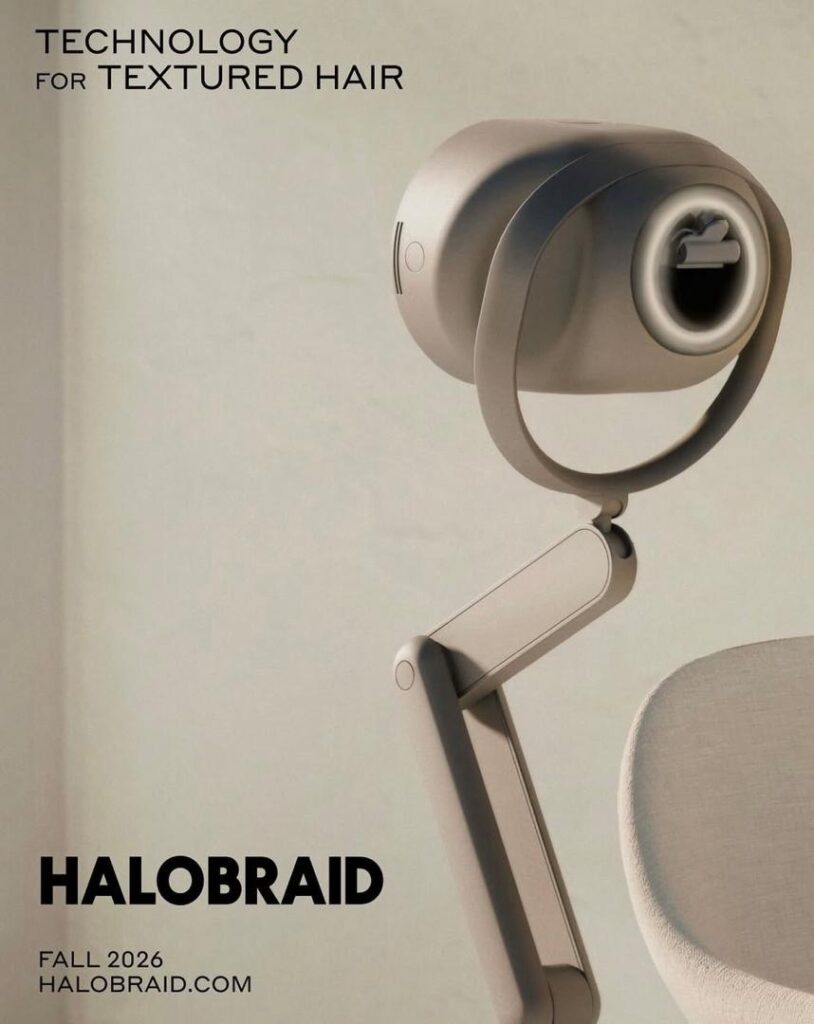
Determined to solve the problem, she partnered with cofounder David Afolabi to develop a robotic assistant that supports professional braiders instead of replacing them.
HaloBraid automates the repetitive mid shaft braiding process, one of the most time consuming stages of a braiding appointment. Stylists remain responsible for preparing the client’s hair by sectioning the scalp and creating the initial anchor braid before the robot performs the repetitive braiding sequence. The stylist then completes the hairstyle by trimming and sealing the ends.
Ogunbiyi has consistently emphasized that the technology is designed to enhance the work of skilled professionals rather than eliminate their role.
“I don’t think anything will get lost from the experience. If anything, it enriches it. Technology simply assists with the repetitive movements that consume the most time and place the greatest strain on the body,” she said.
Beyond reducing appointment times, HaloBraid addresses one of the beauty industry’s biggest occupational challenges. Professional braiders often experience long term strain affecting their hands, wrists, shoulders and backs because of repetitive movements performed over many years.
By automating the most physically demanding stage of braiding, HaloBraid could help salon owners increase productivity, serve more clients each day and extend the careers of experienced hairstylists.
The launch also comes as demand for protective hairstyles continues to grow worldwide. Industry research cited by the company suggests that nearly 95 percent of surveyed Black women would choose protective hairstyles more frequently if salon appointments required less time and physical effort.

For African entrepreneurs and innovators, HaloBraid represents more than a beauty technology breakthrough. It demonstrates how homegrown talent can combine engineering, entrepreneurship and cultural understanding to create globally scalable solutions that attract world class investors while solving everyday challenges.