Physical Address
304 North Cardinal St.
Dorchester Center, MA 02124
Physical Address
304 North Cardinal St.
Dorchester Center, MA 02124

Amplifying African Entrepreneurs voices, one story at a time
Amplifying African Entrepreneurs voices, one story at a time
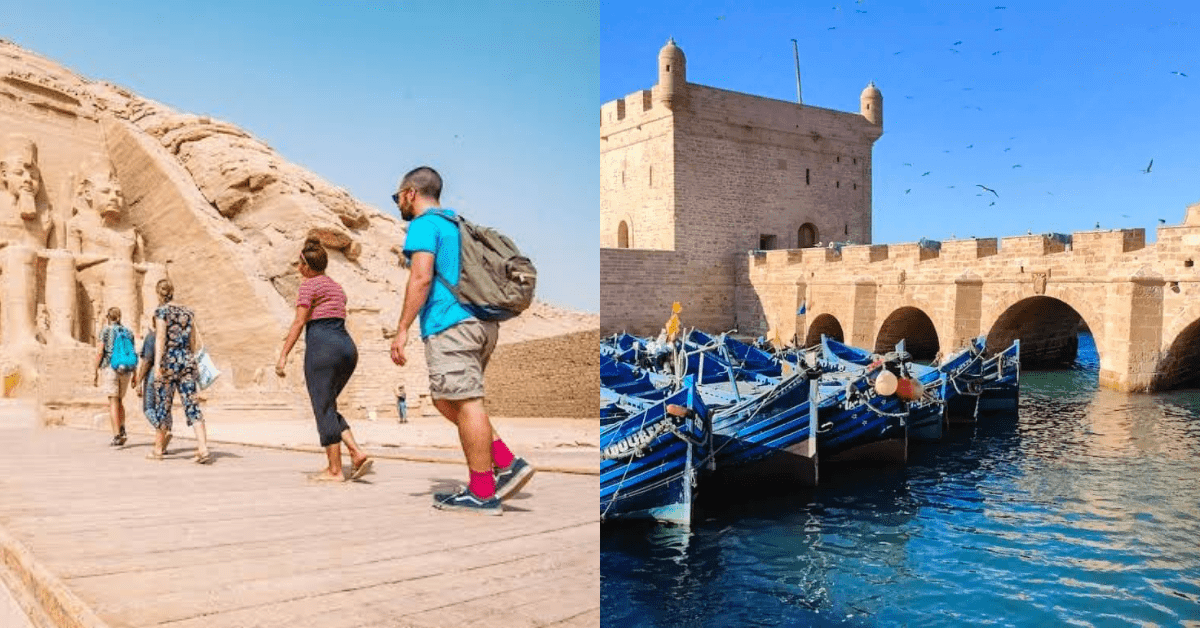
Morocco and Egypt are no longer just historic postcards of Africa’s past. They are fast becoming blueprints for the continent’s tourism future.
In 2025, both nations rewrote the travel record books. Morocco welcomed 19.8 million visitors, a 14% jump from the previous year. Egypt followed closely with 19 million arrivals, marking a powerful 21% surge.
Together, they confirmed what industry insiders already sensed: Africa’s tourism revival is no longer a projection. It is happening now.
And it is happening at scale.
A comeback shaped by confidence
Only a few years ago, global travel collapsed under the weight of the pandemic. Borders closed. Flights disappeared. Hotels dimmed their lights.
Today, North Africa glows again.
Tourism has returned as a major economic engine, creating jobs, attracting foreign currency, and restoring investor confidence. According to UN Tourism and the World Travel & Tourism Council, Morocco and Egypt continue to outperform most destinations south of the Sahara.
More importantly, they are doing it with strategy, not luck.
Morocco’s reinvention beyond postcards
Morocco’s tourism boom reflects something deeper than rising numbers. It reflects redesign.
Tourism Minister Fatim-Zahra Ammor calls it a “deep transformation.” The sector now contributes about 8% of the country’s $178 billion economy, and growth shows no sign of slowing.
Arrivals already stand 50% higher than pre-pandemic levels. Even the devastating 2023 earthquake near Marrakech failed to stall momentum.
Instead, the country doubled down.
Marrakech’s legendary central square is undergoing renewal. Airports are expanding. Roads are improving. Hotels are multiplying.
Meanwhile, Morocco’s skies are busier than ever.
Royal Air Maroc has rolled out new European connections and added aircraft as part of a long-term plan to grow its fleet to 200 planes by 2038. Direct flights to the United States and China now shorten distances that once felt vast. Low-cost carrier Ryanair adds affordable access from multiple European cities.
As a result, travel feels easier. Faster. More connected.
Then came football.
In December, tens of thousands of fans from across Africa and the diaspora poured into the country for the Africa Cup of Nations, hosted from December 21 to January 18. Hotels filled. Streets pulsed. Local businesses thrived.
Looking ahead, Morocco aims even higher.
The country targets 26 million annual visitors by 2030, when it will co-host the FIFA World Cup with Spain and Portugal.
For Morocco, tourism is no longer seasonal. It is strategic.
Egypt’s timeless appeal meets modern ambition
Across the border, Egypt tells a different story yet reaches the same destination.
Despite ongoing regional tensions and war in neighboring Gaza, tourists continue to arrive.
They come for history. They stay for experience.
The opening of the $1 billion Grand Egyptian Museum in November changed everything. Sitting beside the Pyramids of Giza, the museum blends ancient civilization with modern spectacle. Since its unveiling, crowds have flowed steadily through its vast halls.
Beyond Cairo, the Red Sea resorts of Sharm El-Sheikh and Hurghada remain magnets for global travelers. Sun-seekers, divers, and digital nomads keep the beaches alive year-round.
At the same time, Egypt is reshaping its Mediterranean coastline. New developments aim to attract international visitors, not just domestic holidaymakers.
Even Cairo is reinventing itself.
Luxury hotels rise. Historic downtown streets regain their color. Restoration projects circle the ancient citadel. The capital is polishing its global image, one block at a time.
Tourism Minister Sherif Fathi recently confirmed that hotel occupancy has already hit 100% in some areas. The country now targets more than 20 million visitors in 2026 and 30 million annually by 2031.
For a nation built on legacy, the future is becoming just as important.
More than travel numbers
Tourism in Africa is often discussed in statistics. However, in Morocco and Egypt, it tells a human story.
It means jobs for guides in Fez. It means full restaurants in Marrakech. It means artisans selling crafts again. It means Nile cruise workers returning to steady income.
It also reshapes perception.
For decades, global narratives framed African travel through risk. Today, travelers see innovation, culture, infrastructure, and confidence.
That shift matters.
Africa’s tourism spotlight moves north — for now
No single organization tracks every arrival across Africa. Still, industry data confirms one truth: Morocco and Egypt currently lead the continent.
Yet their success sends a wider signal.
With the right investment, strong branding, modern infrastructure, and political will, African tourism can compete globally.
Morocco and Egypt have shown what is possible.
Now the continent is watching.
And the world is arriving.