Physical Address
304 North Cardinal St.
Dorchester Center, MA 02124
Physical Address
304 North Cardinal St.
Dorchester Center, MA 02124

Amplifying African Entrepreneurs voices, one story at a time
Amplifying African Entrepreneurs voices, one story at a time

The global economic order is shifting fast in 2025, and the numbers reveal a powerful reality. While the United States remains the world’s largest economy at $30.62 trillion, individual American states now rival entire nations. In fact, 19 U.S. states rank among the world’s 50 largest economies this year, according to projections from the International Monetary Fund and data from the U.S. Bureau of Economic Analysis.
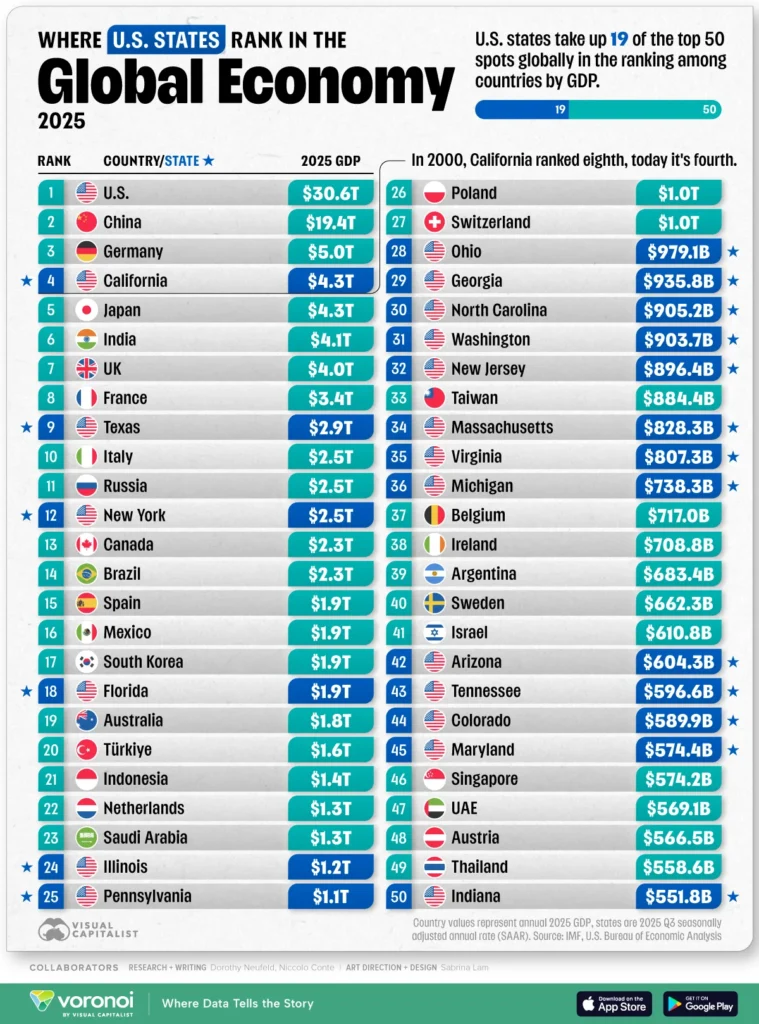
At the center of this economic surge stands California. The Golden State now holds the position of the world’s fourth-largest economy with a GDP of $4.30 trillion. It has moved ahead of Japan at $4.28 trillion and India at $4.13 trillion. Only the United States, China, and Germany produce more economic output. Technology innovation, real estate expansion, and a dominant finance sector continue to fuel California’s rise. Moreover, the state’s real GDP per capita has climbed 60 percent since 2000, far above the national average growth of 37 percent during the same period.
Meanwhile, Texas strengthens its global economic footprint with a GDP of $2.94 trillion, ranking ninth worldwide. The Lone Star State now surpasses both Italy and Russia, which each record $2.54 trillion. Rapid population growth, a booming energy sector, and business-friendly policies continue to attract corporations and capital into Texas. As a result, the state has positioned itself as one of the strongest economic engines in North America.
In addition, New York commands a $2.50 trillion economy, placing it 12th globally. Its output exceeds that of Canada, which stands at $2.28 trillion. Financial services, global trade, media, and technology remain the backbone of New York’s economic power. Consequently, the state maintains influence well beyond U.S. borders.
Further down the rankings, Illinois posts a GDP of $1.22 trillion. That figure comes close to Saudi Arabia at $1.27 trillion, one of the world’s largest oil producers. This comparison highlights the enormous scale of America’s state-level economies. Even states outside the top ten compete directly with established global energy giants.
Across the broader ranking, the United States leads at $30.62 trillion, followed by China at $19.40 trillion and Germany at $5.01 trillion. The top tier also includes Japan, India, the United Kingdom, France, Brazil, and Spain. However, the growing presence of U.S. states inside the global top 50 signals a deeper structural shift in economic power.
Clearly, America’s economic dominance no longer rests solely at the federal level. Instead, state economies now operate at scales comparable to G7 nations and emerging market leaders. Therefore, investors, policymakers, and global institutions must increasingly monitor state-level data to understand the true direction of global GDP rankings in 2025.
The latest projections confirm a defining trend: U.S. states have evolved into global economic heavyweights. As growth continues across technology, energy, finance, and innovation sectors, these states will likely strengthen their positions among the world’s largest economies in the years ahead.
Here’s how the top 15 economies rank in 2025:
1. United States – $30.62T
2. China – $19.40T
3. Germany – $5.01T
4. California – $4.30T
5. Japan – $4.28T
6. India – $4.13T
7. United Kingdom – $3.96T
8. France – $3.36T
9. Texas – $2.94T
10. Italy – $2.54T
11. Russia – $2.54T
12. New York – $2.50T
13. Canada – $2.28T
14. Brazil – $2.26T
15. Spain – $1.89T