Physical Address
304 North Cardinal St.
Dorchester Center, MA 02124
Physical Address
304 North Cardinal St.
Dorchester Center, MA 02124

Amplifying African Entrepreneurs voices, one story at a time
Amplifying African Entrepreneurs voices, one story at a time
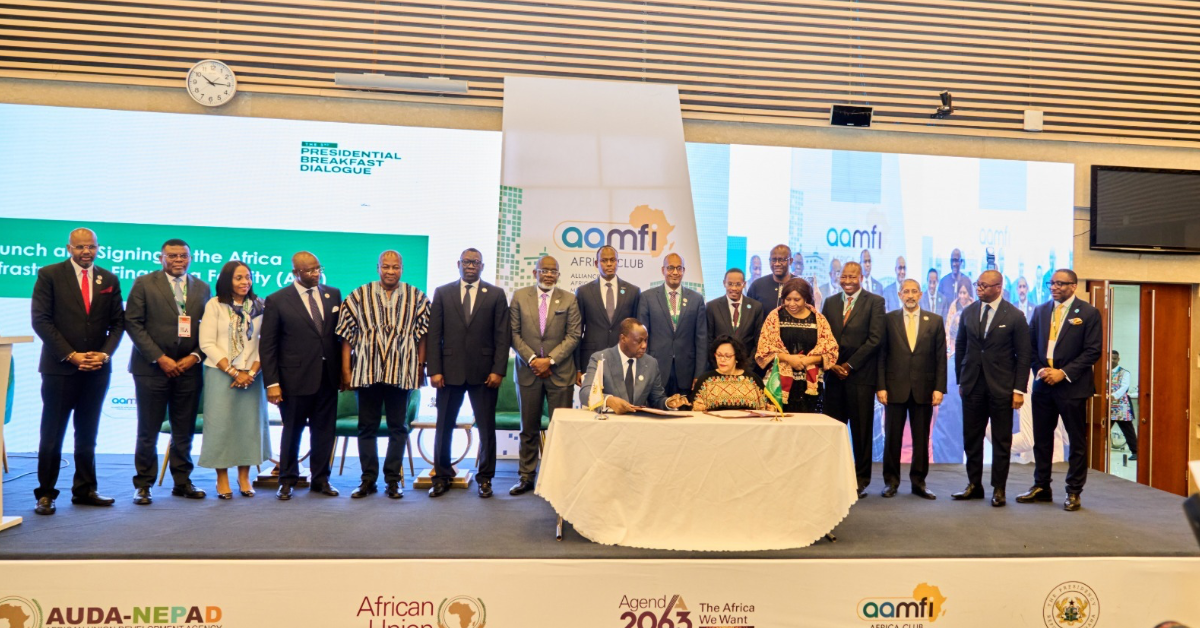
African Heads of State and Government officially launched the Africa Infrastructure Financing Facility (AIFF) on February 14, 2026, marking a major step in boosting Africa’s financial sovereignty. The facility aims to accelerate preparation and financing of priority cross-border infrastructure projects aligned with Agenda 2063. The launch took place during the Third Presidential High-Level Dialogue of the Alliance of African Multilateral Financial Institutions (AAMFI), held on the sidelines of the 39th African Union Summit, under the theme: “Strengthening Africa’s Financial Architecture to Finance Agenda 2063.”
Hosted under the patronage of H.E. John Dramani Mahama, President of Ghana and African Union Champion on AU Financial Institutions, the Dialogue emphasized Africa’s commitment to mobilizing domestic capital to fund infrastructure, industrialization, and job creation. “Africa has domestic capital pools exceeding $2.5 trillion,” President Mahama stated. “The challenge is not capital scarcity, but directing it strategically toward transformative projects that realize Agenda 2063 and boost the African Continental Free Trade Area.” He further stressed the need for a coherent continental financial architecture to reduce reliance on fragmented financing systems that misprice Africa’s development risk.
H.E. Mrs. Francisca Tatchouop Belobe, AU Commissioner for Economic Development, Trade, Tourism, Industry and Minerals, hailed the AIFF launch as a milestone for continental coordination. “This Facility demonstrates the impact of political will coupled with strong institutional alignment. It will help close Africa’s annual infrastructure financing gap, estimated at US$221 billion between 2023 and 2030.”
Samaila Zubairu, President & CEO of Africa Finance Corporation and outgoing AAMFI Chair, highlighted the power of coordinated African capital. “With over $70 billion in collective balance sheets, African Multilateral Financial Institutions can mobilize resources at scale, delivering transformative infrastructure and regional integration.”
Dr. George Elombi, Afreximbank President and Board Chairman, explained the Facility’s role in bridging the gap between political approval and financial execution. “Many projects stall not due to irrelevance but because of weak preparation or misalignment with long-term capital requirements. The AIFF unites African expertise, balance sheets, and risk frameworks to enable large-scale investment.”
Dr. Corneille Karekezi, incoming AAMFI Chair and CEO of Africa Reinsurance Corporation, stressed the importance of institutional collaboration. “By sharing risks and mobilizing both domestic and private capital, Africa can create a resilient financial ecosystem capable of delivering industrial growth and infrastructure across the continent.”
The AIFF, established under a Cooperation Framework Agreement between AUDA-NEPAD and AAMFI, provides an Africa-led coordination mechanism for project preparation and indicative, non-binding financing engagements. Its launch underscores Africa’s determination to operationalize African Union Financial Institutions and foster long-term, sustainable development finance. The Dialogue also witnessed a historic milestone as the Republic of Cameroon formally deposited the Instrument of Ratification for the African Monetary Fund (AMF) Protocol and Statutes, reinforcing continental efforts to promote macroeconomic stability and financial cooperation among AU Member States.
With the AIFF now operational, Africa is positioned to transform its infrastructure financing landscape, reduce reliance on fragmented external capital, and accelerate the continent’s path toward Agenda 2063 objectives.