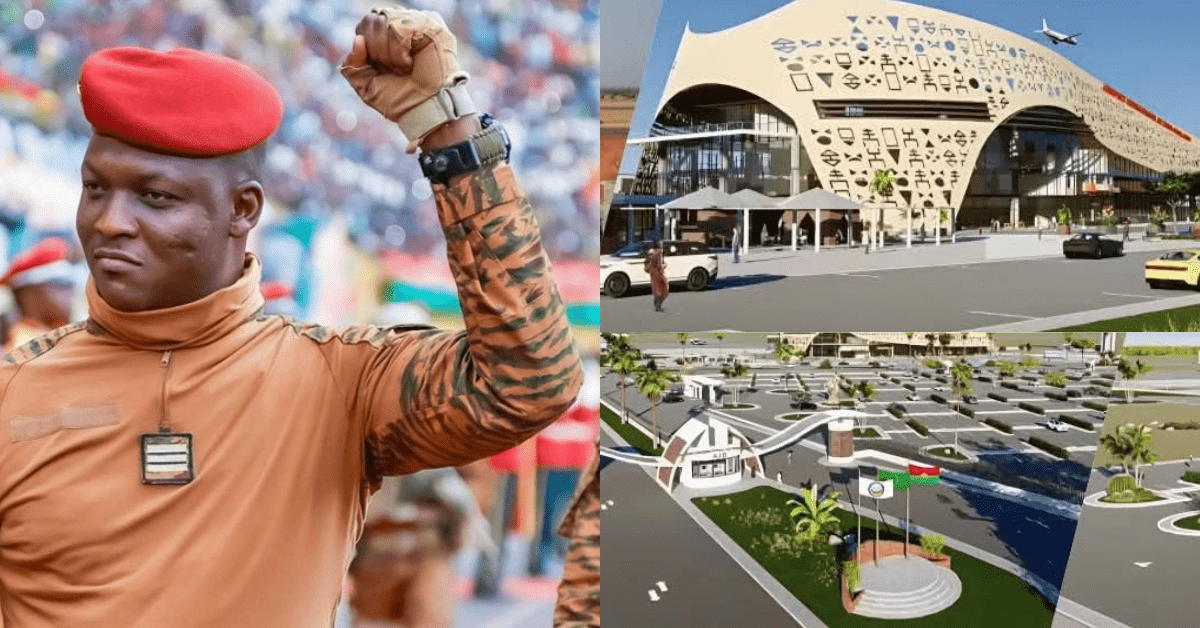
Burkina Faso nears completion of the €220 million Ouagadougou-Donsin International Airport under President Ibrahim Traoré. More than an infrastructure project, the new airport symbolizes national pride, independence, and a bold vision for economic growth and regional connectivity.
The Ouagadougou-Donsin International Airport, is a transformative project located about 35 km northeast of the capital, Ouagadougou. Located about 35 kilometers northeast of the capital Ouagadougou, the new Ouagadougou-Donsin International Airport is expected to replace the aging Bobo Dioulasso International Airport, which dates back to the colonial era.
With construction now around 90 percent complete, the airport is anticipated to become operational by late 2025 or early 2026. The project, which began in 2021 after years of planning since 2004, had faced delays due to political instability, including two coups in 2022. Funded by over €220 million secured from institutions such as the World Bank, African Development Bank (AfDB), West African Development Bank (BOAD), and the ECOWAS Bank for Investment and Development, it reflects Burkina Faso’s vision of economic growth rooted in African-led development.
Once completed, the facility will feature a main runway stretching 3,500 meters, extendable to 4,000 meters to accommodate large aircraft, and a terminal area of about 17,000 square meters capable of serving over one million passengers annually in its initial phase. The site also includes modern cargo terminals, an advanced control tower, and sustainability measures such as solar energy installations. Construction suffered a tragic setback in December 2022 when a building collapsed, resulting in the deaths of seven workers and injuries to six others.
Following this, the military government reviewed ongoing projects to ensure safety and quality. Since coming to power in September 2022, President Ibrahim Traoré has emphasized the airport as more than just infrastructure, framing it as a symbol of Burkina Faso’s move away from neocolonial influence and its pursuit of sovereignty and African unity. The airport is expected to create thousands of direct and indirect jobs, improve regional connectivity, boost tourism and trade, and attract international investment, positioning Burkina Faso as a new cargo and business hub in West Africa.
Public support for the project remains strong, with state media describing it as a “Project of the People, by the People, for the People.” As Burkina Faso approaches the opening of the Ouagadougou-Donsin International Airport, the project stands as both a practical and deeply symbolic step toward a new national narrative centered on modernization, economic independence, and pride.
This new airport is set to handle over a million passengers annually and boost trade, jobs, and connectivity, the airport represents a bold vision for Burkina Faso’s place in West Africa and beyond.