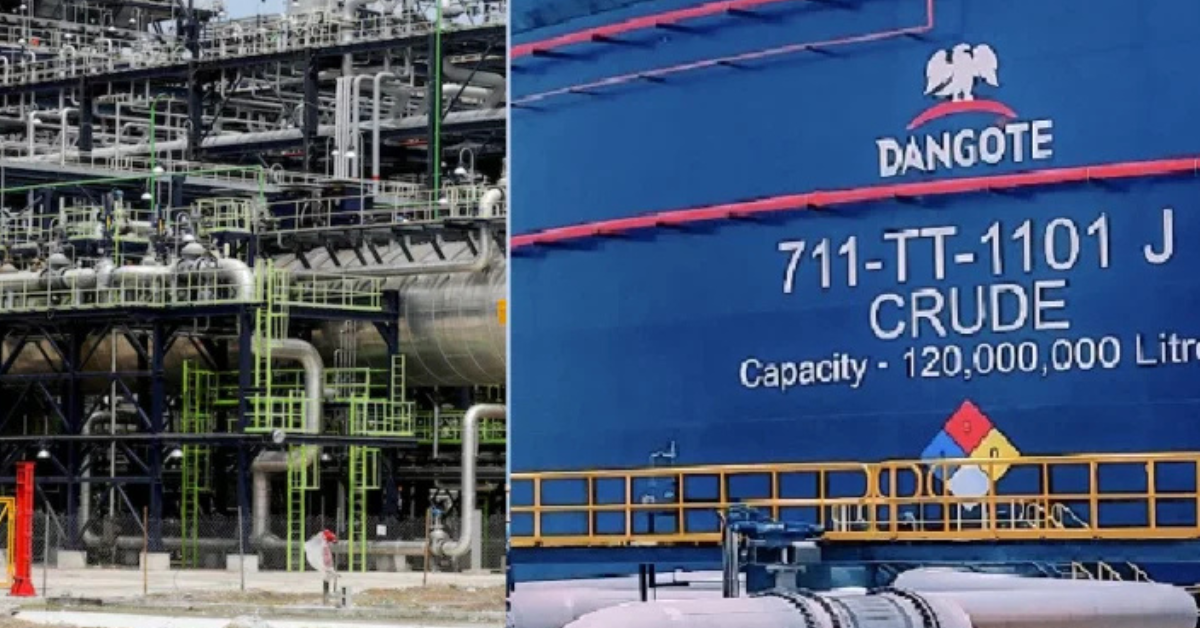
Nigeria’s push for fuel self-sufficiency has gained strong momentum after the Dangote Petroleum Refinery signed a landmark offtake agreement with 12 major marketers to distribute up to 65 million litres of Premium Motor Spirit daily across the country. The deal marks one of the most significant shifts in Nigeria’s downstream petroleum sector in decades.
Billionaire industrialist Aliko Dangote disclosed the agreement in Lagos, confirming that the refinery will prioritise the domestic market while retaining export capacity. He stated that the framework guarantees up to 65 million litres per day for Nigeria. He also confirmed that any surplus, estimated between 15 and 20 million litres daily, will be exported to regional markets.
Currently, Nigeria consumes between 50 million and 60 million litres of petrol each day. Therefore, the new supply structure comfortably exceeds national demand. As a result, the refinery can stabilise local availability while creating additional foreign exchange opportunities through exports. On a monthly basis, production is projected to range between 1.8 billion and 2 billion litres, depending on operational output.
Industry analysts believe the Dangote Refinery petrol deal will ease distribution bottlenecks across the country. Moreover, the agreement is expected to reduce hoarding and limit price volatility, especially as regulators support transparent logistics and supply monitoring. Consequently, marketers will access consistent volumes, while consumers may benefit from improved nationwide supply stability.
The Group Chief Executive Officer of the Nigerian National Petroleum Company Limited, Bayo Bashir Ojulari, recently described the refinery as a transformative national asset. According to him, the facility was originally designed to refine 650,000 barrels per day. However, recent technical reviews show that it has achieved strong live operating performance, reinforcing confidence in its long-term capacity.
Energy experts also link the development to the market-driven reforms introduced by President Bola Tinubu. After removing petrol subsidies and liberalising the downstream sector, the administration encouraged private investment and competition. Consequently, large-scale infrastructure such as the Dangote Refinery now plays a central role in reshaping Nigeria’s energy landscape.
For years, Nigeria depended heavily on imported refined petroleum products despite being Africa’s largest crude oil producer. However, this agreement signals a structural turnaround. By aligning domestic production with national consumption levels, the refinery strengthens Nigeria’s energy security and reduces exposure to global supply shocks.
Furthermore, the export component positions Nigeria as a potential net exporter of refined petroleum products across West and Central Africa. As production scales and logistics improve, the Dangote Refinery petrol deal could redefine regional fuel trade dynamics.
Stakeholders across the energy value chain now view the agreement as more than a commercial milestone. Instead, they see it as a defining moment in Nigeria’s industrial growth story. With consistent implementation and regulatory backing, the refinery’s 65 million litres daily petrol supply framework may anchor a new era of fuel stability, investment confidence, and economic resilience.
.