Deep beneath the surface of Johannesburg lies one of the most extraordinary geological treasures ever discovered. The Witwatersrand Basin in South Africa contains the largest concentration of gold on Earth and has produced roughly 40 percent of all the gold ever mined globally.
Geologists estimate that this vast deposit formed nearly three billion years ago during the Archean Eon. Today, it remains central to both the geology and the economic history of Africa.
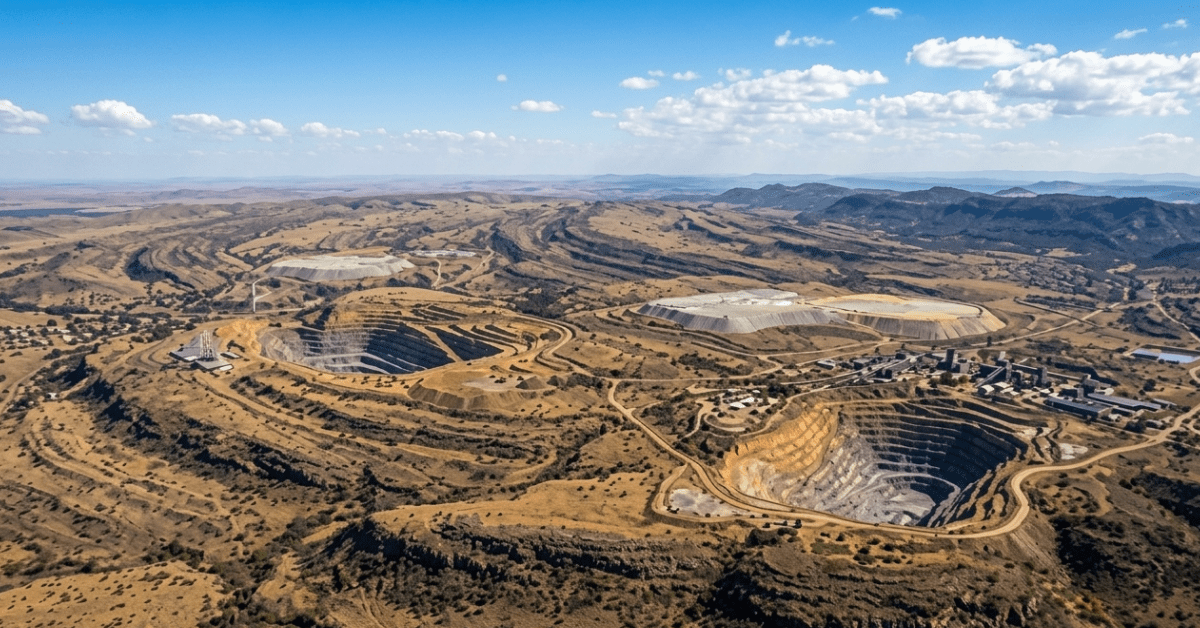
Across Johannesburg, mining towers and expanding highways dominate the landscape. Yet the scarred terrain hides a deeper story. Beneath more than two kilometres of rock lie gold reserves worth over $500 billion, according to geological assessments.
Despite extreme mining depths and seismic risks, the basin continues to attract global attention from researchers and mining companies.
How Ancient Rivers Created the World’s Richest Gold Deposit
The Witwatersrand Basin did not form as a solid mass of metal. Instead, it developed as a sedimentary basin made of layered rocks shaped by ancient rivers, floodplains, and shallow inland seas.
Nearly three billion years ago, powerful rivers flowed across volcanic terrains known as greenstone belts. These rivers eroded mineral-rich rocks and transported fragments downstream.
Because gold is extremely dense, it quickly settled in riverbeds and gravel bars. Over time, sediment buried these deposits under thick layers of rock.
Heat and pressure then compressed the sediments and transformed them into conglomerate rocks, preserving the original river gravels within stone.
Geologists describe this formation as a palaeoplacer deposit—an ancient river deposit that later turned into rock.
Many gold grains inside these conglomerates still show rounded edges, similar to stones shaped by flowing water. This evidence strongly suggests that the gold accumulated in rivers before geological processes buried and preserved it.
Scientific Debate and Modern Geological Evidence
For decades, scientists debated how the Witwatersrand gold deposits formed. Some experts believed the gold crystallized deep underground through hydrothermal processes. Others argued that ancient rivers created the deposits.
Recent research has clarified the debate.
Scientists from the University of Arizona studied isotopic signatures found in the basin’s minerals. Their analysis revealed strong evidence that the gold originated from erosion of nearby greenstone belts during the Archean era.
The findings support the palaeoplacer model, confirming that ancient rivers concentrated the gold first. Later tectonic activity buried and preserved the deposits as continental plates collided.
The surrounding rocks date back 2.7 to 3 billion years, when microbial life dominated Earth and complex organisms had not yet evolved.
As a result, the basin serves not only as a gold reserve but also as a geological archive of early continental formation.
The Discovery That Built Johannesburg
The Witwatersrand Basin transformed South Africa in the late nineteenth century.
On 20 September 1886, President Paul Kruger declared the region open for public gold diggings. Almost immediately, thousands of prospectors arrived, creating a makeshift settlement of tents and mining camps.
Authorities surveyed a piece of land called Randjeslaagte, which lay between several farms. On 8 December 1886, officials auctioned the first 600 stands in the emerging settlement.
The new town was named Johannesburg, combining the names of surveyors Christian Johannes Joubert and Johann Rissik, along with the suffix “burg,” meaning town.
By early 1887, Ferreira’s Camp housed about 3,000 people. Within a decade, the population surpassed 100,000 residents, turning Johannesburg into one of the fastest-growing mining cities in the world.
The growth of the city remained directly tied to the gold reefs of the Witwatersrand Basin.
Deep-Level Mining: Engineering at Extreme Depths
As surface gold deposits gradually declined, mining companies began drilling deeper underground.
The Witwatersrand Basin soon became famous for deep-level mining technology.
Several mine shafts now reach depths of more than four kilometres below the surface. At these depths, temperatures can exceed 50°C, while immense rock pressure increases the risk of seismic rock bursts.
To manage these conditions, mining companies installed massive refrigeration systems that cool underground workspaces. Engineers also reinforced tunnels with advanced structural supports.
Despite these challenges, the basin produced enormous quantities of gold for more than a century.
Although annual output has declined from peak production levels, the region remains one of the most important gold mining areas on Earth.
A Gold Legacy That Still Shapes Africa
Formed during the Archean era and first exploited commercially in 1886, the Witwatersrand Basin continues to define South Africa’s mining legacy.
Industry records and geological surveys indicate that the basin has produced about 40 percent of all gold mined in modern history.
Even today, enormous untapped reserves remain buried deep underground.
For scientists, the basin offers clues about Earth’s early geological evolution. For the global mining industry, it remains one of the most valuable mineral discoveries ever made.
And for Johannesburg, it represents the geological foundation on which the city itself was built.