The Ugandan government has launched a Shs28 billion Creative Uganda Revolving Fund (CURF) to expand affordable financing, strengthen intellectual property protection, and accelerate job creation across the country’s fast-growing creative industry.
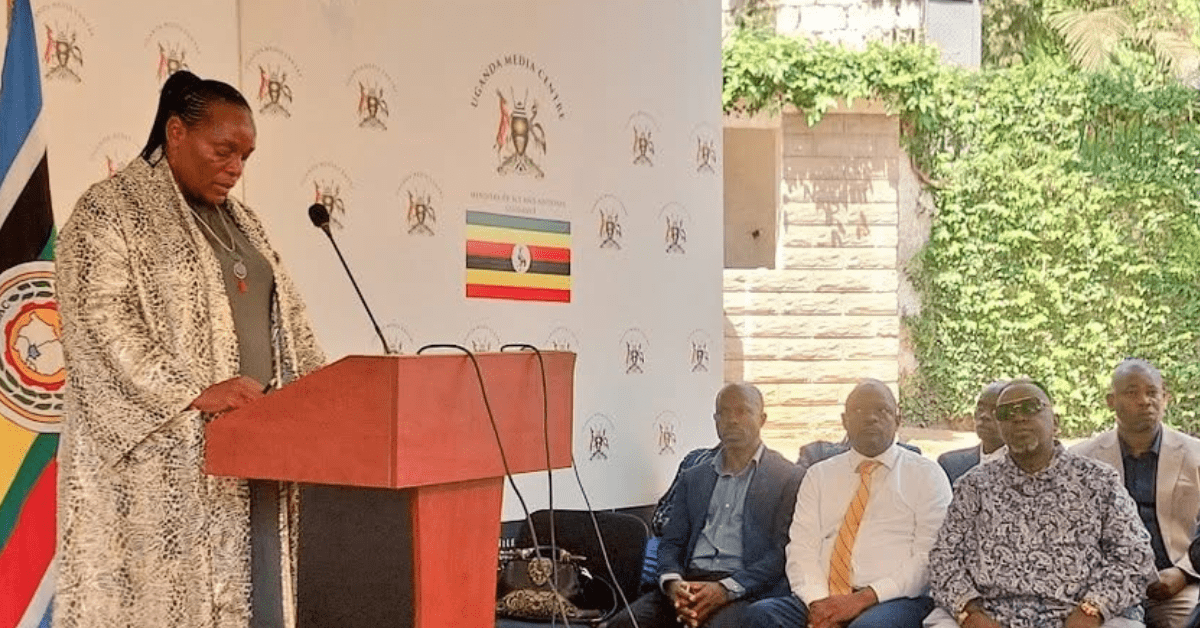
The Minister of State for Gender and Culture, Peace Regis Mutuuzo, announced the initiative on Wednesday during a media briefing at the Uganda Media Centre in Kampala. The fund, first introduced in July 2025, directly tackles long-standing barriers in the sector, especially limited access to capital, weak formal business structures, and the poor monetisation of creative assets.
According to Mutuuzo, the government now views creativity as a strategic economic pillar rather than a side activity.
“Creativity is not a hobby. It is a viable economic activity capable of transforming lives and communities,” he said.
How the Shs28bn Fund Will Work
To ensure wide impact, the government has structured the Shs28 billion allocation into three major pillars.
First, Shs5 billion will support Musician SACCOs under the Uganda National Musician Federation.
Second, another Shs5 billion will strengthen copyright administration and royalty collection systems nationwide.
Third, the remaining Shs18 billion will fund SACCOs across nine other creative fields.
These sectors include film, performing arts, fashion, publishing, digital content creation, culinary arts, and other cultural industries that increasingly drive youth employment.
Notably, CURF operates as a revolving fund. Beneficiaries will repay loans under agreed terms, allowing the government to recycle the capital and support more creators over time.
In addition, loans will attract a 5 percent interest rate and flexible repayment schedules. This structure reflects the seasonal and project-based nature of creative work, where income often comes in stages rather than monthly cycles.
However, the fund goes beyond financing.
The programme will also deliver capacity-building support in financial literacy, business management, intellectual property awareness, market access, and digital technology adoption. As a result, artists can grow from informal creators into scalable business owners.
Importantly, the government will recognise intellectual property rights and performance contracts as alternative collateral. This move allows artists to leverage their work as a bankable asset, a major shift for a sector that traditionally struggles with formal credit access.
Already, implementation has begun.
Mutuuzo confirmed that the government has disbursed Shs9.5 billion to partners such as the Uganda National Musician Federation, WALK Creative Arts Foundation, and copyright agencies including UPRS, URRO, and UFMI.
Furthermore, authorities have allocated Shs2 billion to develop a national Copyright Management System, which will modernise royalty tracking and improve transparency for rights holders.
At the same time, the government has set aside Shs1 billion to support the upcoming Uganda One Art and Culture Festival. The festival will showcase creative products while also serving as the official public launch platform for CURF.
To safeguard the programme, the ministry has introduced strict governance structures. These include independent monitoring, clear eligibility rules, and firm protections against misuse or political interference.
Moreover, the fund will prioritise youth- and women-led enterprises, registered creative businesses, and projects with strong market potential and employment capacity.
Government projections suggest the Creative Uganda Revolving Fund will support thousands of creative enterprises, generate sustainable jobs, raise household incomes, expand cultural exports, and significantly increase the creative sector’s contribution to Uganda’s GDP.
As African countries increasingly tap into culture, fashion, music, film, and digital content as engines of growth, Uganda’s latest move positions its creative economy as a serious driver of national development not just artistic expression.