Physical Address
304 North Cardinal St.
Dorchester Center, MA 02124
Physical Address
304 North Cardinal St.
Dorchester Center, MA 02124

Amplifying African Entrepreneurs voices, one story at a time
Amplifying African Entrepreneurs voices, one story at a time
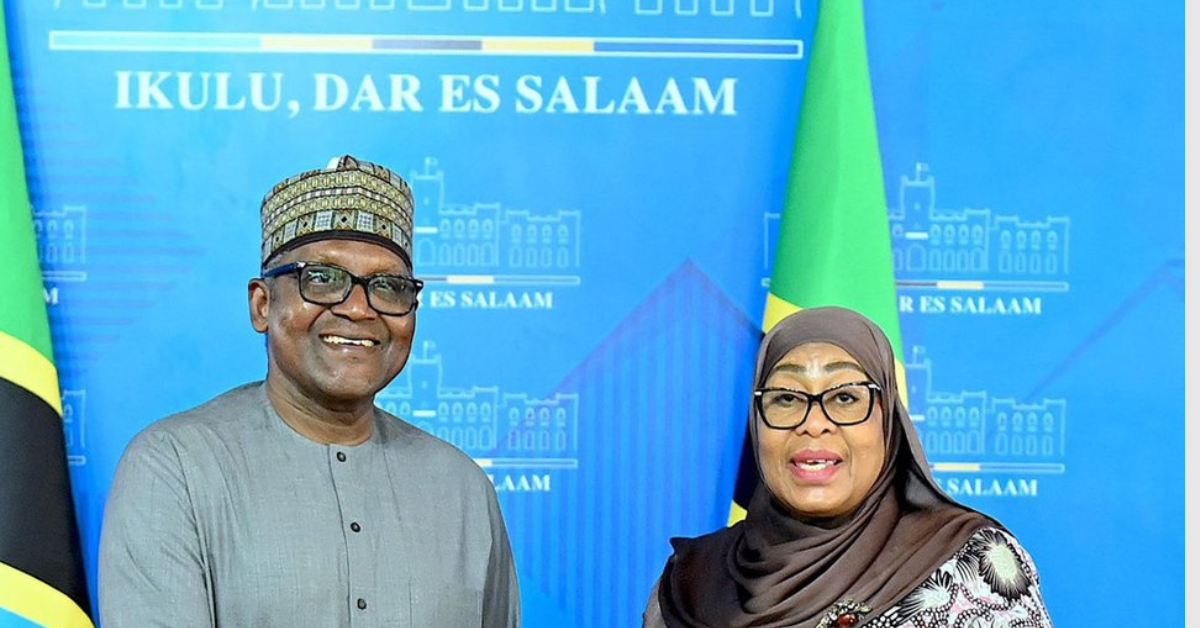
Africa’s richest man, Aliko Dangote, has taken another significant step toward expanding his business empire across East Africa after the Tanzanian government officially opened technical negotiations on a series of proposed investments spanning fertiliser production, energy and transport infrastructure.
The decision marks one of the continent’s most closely watched investment developments. Moreover, it reinforces Tanzania’s growing ambition to become a leading manufacturing powerhouse while intensifying competition with Kenya for one of Africa’s largest private-sector industrial projects.
President Samia Suluhu Hassan instructed government ministries and agencies to immediately begin detailed discussions with representatives from Dangote Group following a high-level meeting in Dar es Salaam. The move transforms preliminary discussions into structured negotiations that could unlock billions of dollars in new investments across multiple sectors.
If the talks succeed, Tanzania could secure one of the country’s largest industrial investment programmes in recent history. At the same time, the projects could accelerate economic diversification, strengthen regional trade and create thousands of new employment opportunities.
“We have identified areas that can deliver significant value for Tanzania, and we are ready to work together to develop them for mutual benefit,” Dangote said after the meeting.
His vision aligns with a strategy that has defined the Dangote business empire for decades. Rather than exporting raw materials, the group focuses on building industries that process local resources into high-value products. That approach has helped the company become a dominant force in cement, fertiliser, petrochemicals and oil refining across Africa.
The current negotiations centre on three industries that sit at the heart of Tanzania’s long-term economic strategy: fertiliser production, energy and transport infrastructure.
Among them, fertiliser manufacturing could deliver immediate economic benefits. Farmers throughout East Africa still rely heavily on imported fertiliser, exposing agricultural production to global supply disruptions, rising shipping costs and volatile international prices. Consequently, local production would reduce import dependence, lower farming costs and improve food security across the region.
In addition, Tanzania could emerge as a major fertiliser supplier to member states of the East African Community, strengthening its position within the regional agricultural value chain.
Dangote Group enters these negotiations with considerable experience. Its fertiliser complex in Nigeria remains Africa’s largest granulated urea production facility, producing approximately three million metric tonnes annually for domestic consumption and export markets.
Energy represents another critical pillar of the proposed investment package. Tanzania possesses an estimated 57 trillion cubic feet of proven natural gas reserves, making it one of East Africa’s most resource-rich energy markets. Since natural gas serves as the primary feedstock for urea production, reliable access to gas remains a decisive factor for global fertiliser manufacturers evaluating new investment destinations.
The country’s southern Mtwara region offers additional strategic advantages. It combines abundant gas reserves, access to the Port of Mtwara and available industrial land, creating favourable conditions for large-scale manufacturing operations.
Dangote also understands Tanzania’s investment landscape. His three-million-tonne-per-year cement plant in Mtwara ranks among the country’s largest industrial projects. Over the years, the facility has supplied both domestic and neighbouring markets while giving the group valuable operational experience and strong working relationships with local regulators.
Meanwhile, the negotiations highlight an increasingly competitive investment race unfolding across East Africa.
Both Tanzania and Kenya are positioning themselves as preferred destinations for Dangote’s future industrial expansion, including the proposed East African refinery that has attracted significant regional attention.
Kenyan President William Ruto has repeatedly expressed interest in hosting the refinery. Mombasa continues to emerge as a strong contender because of its deep-water port, established petroleum infrastructure and sizeable domestic fuel market. Nevertheless, Tanzania is leveraging its natural gas resources, industrial expansion strategy and improving investment climate to strengthen its own position.
The coming months will prove decisive.
Technical teams from Dangote Group and Tanzanian government agencies are expected to negotiate land allocation, gas supply agreements, transport infrastructure, regulatory approvals and commercial frameworks required to move the projects from concept to execution.
Those discussions will ultimately determine whether Tanzania can convert political goodwill into bankable investments capable of attracting billions of dollars in private capital.
For President Samia Suluhu Hassan, securing the investment package would reinforce her administration’s industrialisation agenda, increase value addition to Tanzania’s natural resources and position the country as a manufacturing and logistics gateway serving both East and Central Africa.
For Dangote, the negotiations represent another chapter in exporting the industrial model that transformed Nigeria into one of Africa’s leading manufacturing economies. Success in Tanzania would further strengthen his vision of building integrated industries that power regional growth, expand intra-African trade and create lasting economic value across the continent.
As negotiations advance, investors, policymakers and manufacturers across Africa will closely watch the outcome. A successful agreement would not only reshape Tanzania’s industrial future but also redefine the competitive landscape of East Africa’s manufacturing economy.