Physical Address
304 North Cardinal St.
Dorchester Center, MA 02124
Physical Address
304 North Cardinal St.
Dorchester Center, MA 02124

Amplifying African Entrepreneurs voices, one story at a time
Amplifying African Entrepreneurs voices, one story at a time
Samsung Electronics has emerged as one of the biggest winners of the global artificial intelligence explosion. The South Korean tech giant rode soaring demand for memory semiconductors to a near $1 trillion valuation, strengthening its dominance in the global AI supply chain and helping Seoul’s stock market climb among the world’s largest financial markets.
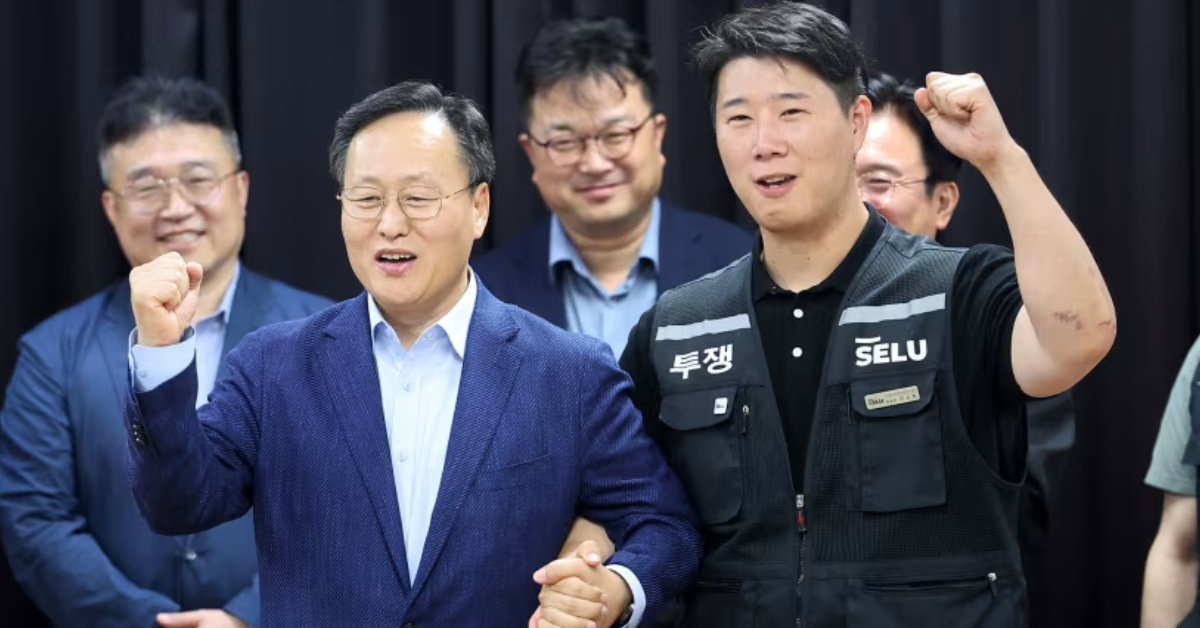
However, while investors celebrated the AI gold rush, Samsung workers pushed back and demanded a larger share of the company’s historic profits.
Tens of thousands of Samsung employees threatened to launch an unprecedented strike that could have disrupted one of the world’s most important semiconductor production lines. The move sent shockwaves through the global tech industry because Samsung supplies critical memory chips used in AI systems developed by companies like Nvidia, AMD, Google and Amazon.
Just hours before the planned strike began, Samsung unions and management reached a tentative agreement that temporarily avoided what could have become the largest labor walkout in the company’s history.
The proposed strike involved more than 48,000 workers, nearly 40% of Samsung’s Korean workforce, over an 18-day period. Many of those employees work directly in memory chip production, an industry currently experiencing overwhelming demand because of the rapid expansion of artificial intelligence infrastructure worldwide.
The labor standoff alarmed both government officials and global technology executives. Samsung alone contributed more than 12% of South Korea’s GDP last year, making the company deeply tied to the country’s economic stability.
South Korean Prime Minister Kim Min-seok warned that any disruption to Samsung’s semiconductor operations could damage the national economy and intensify pressure on the already strained global chip supply chain.
The timing of the dispute revealed a growing reality inside the AI economy. As tech companies pour billions into artificial intelligence, workers increasingly want better compensation and stronger protections while corporations post record-breaking profits.
This year alone, companies including Meta, LinkedIn, Snap and Amazon announced layoffs, restructuring or workforce changes linked to their AI strategies. Meanwhile, Samsung workers argued that the company’s AI-driven profits justified a major upgrade in employee compensation.
Samsung recently reported quarterly profits that surged more than eightfold compared with the same period last year. The company even surpassed its entire 2025 operating profit within a single quarter, fueled largely by relentless demand for advanced memory chips.
Workers quickly pointed to rival semiconductor giant SK Hynix as proof that Samsung employees deserved more competitive bonuses.
SK Hynix revised its bonus structure earlier this year and removed restrictions that capped employee payouts. Under its updated system, some employees could receive bonuses worth nearly 3,000% of their base salaries in 2025. Reports also showed average annual bonuses reaching 700 million won, approximately $465,000 per employee.
Samsung unions argued that the semiconductor industry has entered a fierce global talent war. They warned that foreign tech firms continue to target experienced Korean chip engineers with increasingly aggressive offers.
As part of the tentative agreement, Samsung agreed to eliminate its existing bonus cap and allocate 10.5% of semiconductor business performance profits toward employee bonuses. The company also acknowledged that labor relations needed improvement after weeks of growing tensions.
At the center of the crisis sits the booming AI memory chip market.
Artificial intelligence systems require enormous amounts of high-speed memory to process and store data efficiently. As companies race to build larger data centers and more powerful AI models, memory chips have transformed from low-margin products into some of the most valuable components in modern technology.
Industry analysts believe the memory shortage could continue through 2028 as global demand keeps accelerating. Research firm SemiAnalysis predicts memory chip prices could more than double compared with 2025 levels.
Samsung now occupies a critical position in that supply chain alongside SK Hynix and Micron Technology.
Although Samsung initially lagged behind SK Hynix during the early stages of the AI boom, the company staged a strong recovery thanks to surging semiconductor demand. Market research from Counterpoint shows SK Hynix currently controls 57% of the AI memory market, while Samsung holds 22% and Micron controls 21%.
Even so, fears of supply disruptions continue to worry the AI industry.
Analysts say any slowdown in Samsung’s memory production could worsen global shortages, increase chip prices and place additional pressure on companies building next-generation AI systems.
For now, investors appear relieved after the temporary agreement boosted Samsung’s shares. Still, uncertainty remains because union members must still vote on the deal before it becomes final.
The near-strike exposed a deeper issue shaping the future of artificial intelligence worldwide. As AI creates unprecedented wealth for technology companies, workers across the industry increasingly expect a larger slice of the profits powering the next digital revolution.