Physical Address
304 North Cardinal St.
Dorchester Center, MA 02124
Physical Address
304 North Cardinal St.
Dorchester Center, MA 02124

Amplifying African Entrepreneurs voices, one story at a time
Amplifying African Entrepreneurs voices, one story at a time
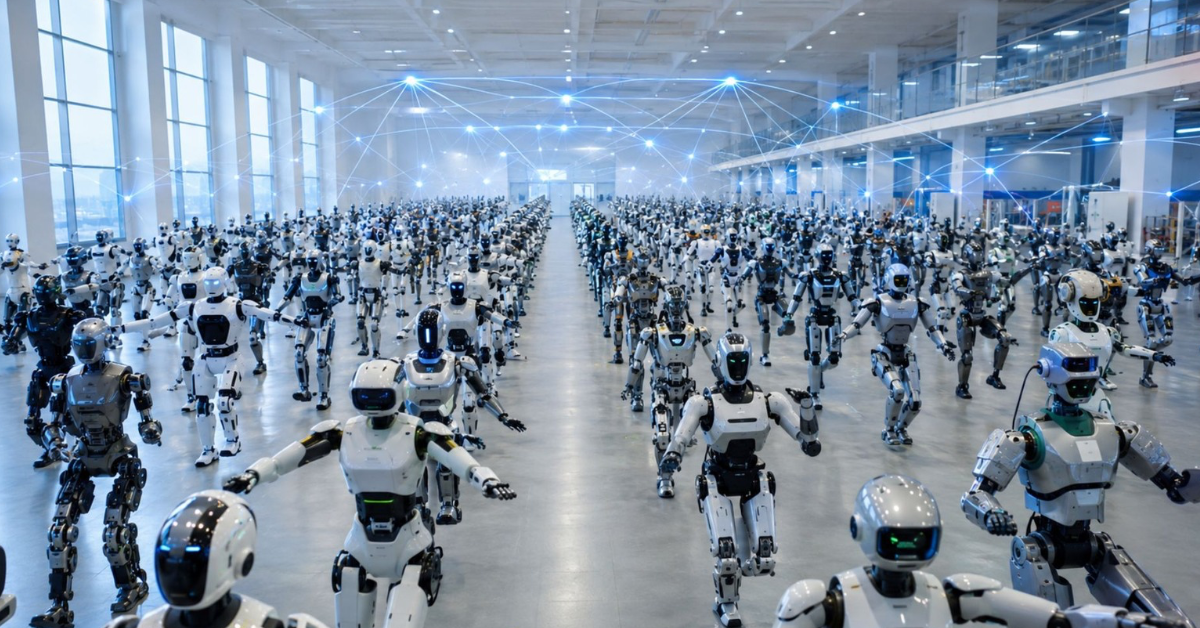
China is preparing to open what many experts describe as one of the most ambitious robotics projects ever attempted.
In July, Shanghai will welcome the world’s first training school designed specifically for humanoid robots, creating an environment where more than 100 robots from different manufacturers will learn, practice, and improve together.
The groundbreaking facility, located inside Shanghai’s Zhangjiang technology hub, represents a major step in China’s race to dominate the global robotics industry.
Unlike traditional development programs that focus on individual robot brands, this initiative encourages collaboration among machines built by more than a dozen companies.
The project aims to achieve something far bigger than teaching robots basic tasks.
Researchers plan to use the massive amount of data generated by the machines to create a shared artificial intelligence system that can accelerate learning across the entire humanoid robotics sector.
According to officials at the National and Local Innovation Center in Humanoid Robotics, the robots will begin their education by mastering 45 foundational skills.
These include grasping objects, transporting items, organizing materials, placing products in specific positions, and performing routine workplace functions.
Although these actions appear simple to humans, they remain some of the most difficult challenges in robotics.
Machines must learn how to adjust grip strength, recognize different object shapes, react to changing conditions, and complete tasks with precision.
To improve performance, each robot will repeat individual movements up to 600 times every day.
Scientists will monitor every attempt and record details such as positioning, pressure levels, speed, accuracy, and overall success rates.
This intensive process will transform the Shanghai facility into one of the world’s largest robotics data-generation centers.
Researchers expect the school to create roughly 50,000 data points daily, resulting in approximately 10 million data points every year.
The diversity of the participating robots plays a critical role in the project’s success. Machines with different body structures, movement capabilities, sizes, and engineering designs will perform identical tasks.
As a result, engineers can compare performance across a wide range of robotic systems and identify the most effective learning methods.
The data collected from these exercises will power what researchers describe as a “superbrain” for future humanoid robots.
Instead of forcing every new machine to learn from the beginning, future robots will gain access to a growing knowledge base built from millions of previous training experiences.
Industry leaders believe this shared intelligence model could dramatically reduce development costs and shorten training periods for robotics companies.
A robot entering the program in the future may instantly benefit from lessons learned by hundreds of predecessors.
The center also plans to establish a data-sharing marketplace for robotics companies.
Businesses developing robots for healthcare, hospitality, manufacturing, logistics, and consumer services will gain access to specialized training information tailored to their industries.
For example, a company building hospital service robots could use movement and interaction data already collected by the training center rather than spending years generating its own datasets.
This approach could significantly accelerate innovation while lowering development expenses.
The first generation of students will focus on 10 critical task categories across domestic environments, industrial settings, and tourism-related services.
Engineers want the robots to perform activities such as folding clothes, organizing shelves, cleaning equipment, transporting materials, and assisting humans in real-world situations.
China has already demonstrated its commitment to large-scale automation. Thousands of robots currently work alongside human employees in advanced manufacturing facilities across the country.
However, the Shanghai robot school represents a new phase of development focused on creating humanoid machines capable of operating in everyday human environments.
If successful, the initiative could reshape the future of artificial intelligence and robotics. More importantly, it could establish a blueprint for how machines learn, collaborate, and evolve collectively.
What once sounded like science fiction is quickly becoming reality. In Shanghai, the classroom of the future will not be filled with human students alone.
Instead, it will be occupied by humanoid robots learning from each other, building a shared intelligence system, and preparing for a future where machines play an increasingly important role in everyday life.